Liberal Reform and Industrial Relations: J.H. Whitley (1866-1935), Halifax Radical and Speaker of the House of Commons by John A. Hargreaves Keith Laybourn Richard Toye
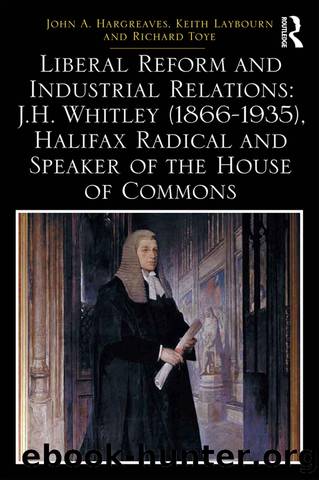
Author:John A. Hargreaves, Keith Laybourn, Richard Toye [John A. Hargreaves, Keith Laybourn, Richard Toye]
Language: eng
Format: epub
Tags: Nonfiction, History, Ireland, British
ISBN: 9781351866125
Publisher: Taylor and Francis
Published: 2017-10-25T04:00:00+00:00
7 J.H. Whitley as Speaker of the House of Commons, 1921â28
Richard Toye
This chapter describes and assesses J.H. Whitleyâs period as Speaker of the House of Commons. Whitley presided over a House that â following the General Election of 1922 â for the first time included a large number of Labour MPs. It was his view that, inexperienced in customs and procedure as they were, it was necessary âto drive them with a loose reinâ. This brought him criticisms from some Conservatives for excessive laxity, but others defended him, on the grounds that stricter treatment would play into the hands of the disrupters. On balance, he was probably quite effective in his efforts to guide Labour into the approved channels of behaviour. Drawing on the Whitley Papers, as well as on contemporary press and diary accounts, this chapter will place Whitleyâs Speakership within the context of the parliamentary and wider political developments of the time.
There were some striking features to J.H. Whitleyâs Speakership. He had a background in the cotton industry, whereas previous Speakers tended to be lawyers or squires. He was also â although of course no-one knew it at the time â the last Liberal Speaker. (The Conservatives then monopolised the position until the election of Horace King, the first Labour Speaker, in 1965.) He served during five premierships: Lloyd George (to 1922); Bonar Law (1922â23); Baldwin (1923â24); MacDonald (1924); and Baldwin again (to 1928). Whitleyâs Speakership witnessed the dramatic fall of the Lloyd George Coalition, the first (minority) Labour Government under Ramsay MacDonald and the 1926 General Strike. As his entry in the Dictionary of National Biography notes, during the strike âhe arranged for parliamentary votes and proceedings to be produced by emergency means. In reply to a threat to withdraw workmen from the houses of parliament he declared that he would not allow the work of the House of Commons to be interfered with, and would, if necessary, conduct the business of the house without printing and by candlelight.â1 As all this suggests, it was a rather tumultuous time.
The turbulence of the period should not be overstated, however. Although much was still up in the air in political terms at the point of his retirement from the Speakerâs Chair, Stanley Baldwinâs Conservative Government did appear to have restored a measure of stability to the country. More than arguably, the tenure of Whitleyâs predecessor, James Lowther, had seen greater upheavals, including the constitutional crisis of 1909â11 and the admission of women to the House of Commons from 1918. On the other hand, Whitleyâs time in office was much more eventful than that of his successor, Edward FitzRoy. It might best be said, then, that Whitleyâs Speakership represented an important transitional phase, one of the most important outcomes of which, along with the decline of the Liberals, was the full integration of the Labour Party into the conventions of Westminster politics.
As David M. Craig has shown, there is no necessary methodological conflict between a âhigh politicsâ approach, focussed on
Download
This site does not store any files on its server. We only index and link to content provided by other sites. Please contact the content providers to delete copyright contents if any and email us, we'll remove relevant links or contents immediately.
The Vikings: Conquering England, France, and Ireland by Wernick Robert(84423)
Ali Pasha, Lion of Ioannina by Eugenia Russell & Eugenia Russell(40336)
The Conquerors (The Winning of America Series Book 3) by Eckert Allan W(38067)
The Vikings: Discoverers of a New World by Wernick Robert(37024)
Cecilia; Or, Memoirs of an Heiress — Volume 1 by Fanny Burney(32654)
Cecilia; Or, Memoirs of an Heiress — Volume 2 by Fanny Burney(32025)
Cecilia; Or, Memoirs of an Heiress — Volume 3 by Fanny Burney(32006)
Empire of the Sikhs by Patwant Singh(23150)
The Secret History by Donna Tartt(19354)
Hans Sturm: A Soldier's Odyssey on the Eastern Front by Gordon Williamson(18665)
Cat's cradle by Kurt Vonnegut(15468)
Pimp by Iceberg Slim(14713)
Sapiens: A Brief History of Humankind by Yuval Noah Harari(14481)
Norse Mythology by Gaiman Neil(13474)
Talking to Strangers by Malcolm Gladwell(13474)
Leonardo da Vinci by Walter Isaacson(13427)
4 3 2 1: A Novel by Paul Auster(12544)
Underground: A Human History of the Worlds Beneath Our Feet by Will Hunt(12172)
The Radium Girls by Kate Moore(12120)
